24/7 Emergency Locksmith Service
Auburn, WA · Commercial Locksmith

Exit Device Installation
in Auburn, WA

Code-compliant exit device installation for Auburn commercial properties. Auburn Lock & Car Keys installs rim, mortise, surface vertical rod, and concealed vertical rod exit devices on offices, retail, and assembly spaces — properly fitted, fire-rated where required.

Exit Devices: The Workhorses of Commercial Egress

Exit devices — also called panic bars, crash bars, or just exits — are the horizontal pushbars across commercial doors that let people exit instantly in emergencies. They're required by code on many commercial doors and they're some of the most heavily-used hardware in any building.

This page focuses on the full installation process. For repair of existing devices, see push bar repair. For a general overview, see panic bar installation. This page goes deeper into the four main exit device types and when each is right.

Four Main Exit Device Types

The right device depends on the door configuration and the level of security and finish you need:

1. Rim Exit Devices

  • Latch mounted on the face (rim) of the door, engaging a strike on the frame
  • Easiest to install, most affordable, most common
  • Used on single doors and the active side of pairs with a center mullion
  • Examples: Von Duprin 99 / 35A series, Sargent 80, Yale 7000
  • Best for: Most standard commercial single doors

2. Mortise Exit Devices

  • Latch mechanism mortises into the door edge (pocket cut into the door)
  • Heavier, stronger, more premium feel
  • More security than rim devices — latch is internal, harder to attack
  • Examples: Von Duprin 33A / 35A mortise, Sargent 80 mortise, Yale 7100M
  • Best for: Higher-security single doors, premium installations, certain code applications

3. Surface Vertical Rod (SVR)

  • Rods on the face of the door running to top and bottom strikes
  • Used on double doors without a center mullion (each leaf latches independently)
  • Visible rods on the door surface
  • Examples: Von Duprin 9927, Sargent 8700 series, Yale 7000 SVR
  • Best for: Pairs of doors where a mullion would be inconvenient

4. Concealed Vertical Rod (CVR)

  • Rods hidden inside the door, running to top and bottom strikes
  • Cleaner appearance than SVR, but more expensive and more involved to install
  • Requires hollow-core or specially-prepared doors
  • Examples: Von Duprin 9947, Sargent 8800 series, Yale 7000 CVR
  • Best for: Architectural / premium installations where appearance matters

Trim Options (Outside Hardware)

Exit devices are exit-only on the inside. The outside of the door has "trim" determining how people enter:

  • Night latch / dummy trim — Pull handle only, no key; exit-only door
  • Key-in-lever — Key access from outside, ADA-compliant lever
  • Key-in-knob — Older style, ADA-restricted for new installations
  • Electrified lever / paddle — Card or app controls entry; integrates with access control
  • Cylinder dogging — Allows the latch to be held retracted with a key (door becomes push-pull during business hours)

Fire-Rated Exit Devices

Doors in fire-rated wall assemblies (typical for stair towers, mechanical rooms, occupancy separations) require fire-rated exit devices — functionally similar to standard devices but UL-labeled to maintain the door's fire rating. Don't substitute non-rated devices on rated doors; it's a code violation and can invalidate your fire compartmentation.

Call (253) 796-8550 for code-compliant exit device installation throughout Auburn and South King County.
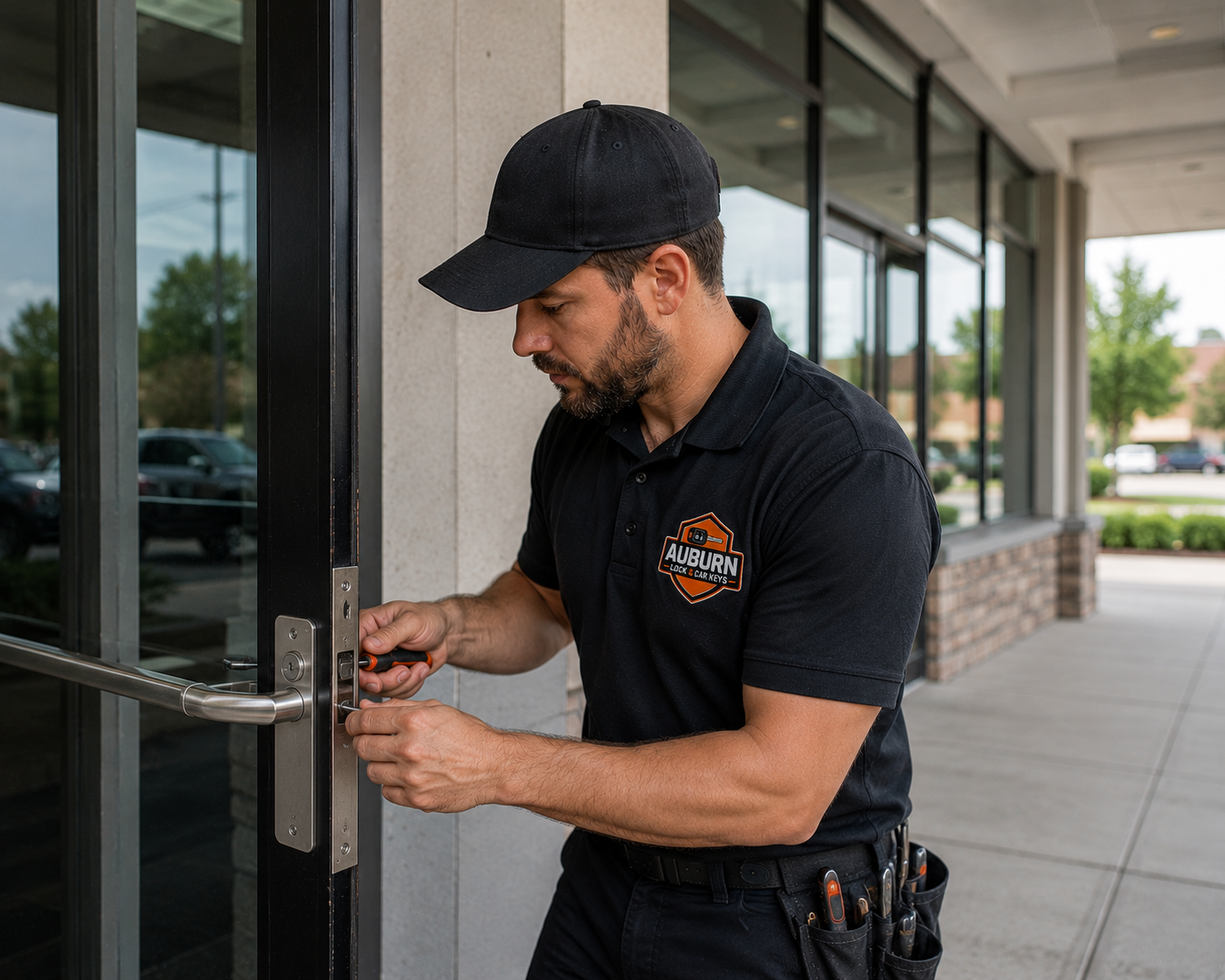
Auburn commercial locksmith installing a Von Duprin rim exit device on a fire-rated commercial door for code compliance
When You Need This Service

Common Reasons Auburn Businesses Call Us

New Build / Tenant Improvement

Commercial space build-out needs exit hardware specified and installed. We work with general contractors and architects.

Code Compliance Update

Fire inspector flagged exit hardware as non-compliant. We install correctly-rated devices that pass re-inspection.

Occupancy Change

Converting space (retail to assembly, office to school) usually triggers exit hardware requirements. We bring the property up to code.

Double Door, No Mullion

Pair of doors with no center post. Needs surface or concealed vertical rod exit devices — we install both.

Our Process

How Exit Device Installation Works

Exit device installation takes 90-180 minutes per door depending on device type and door condition.

01

Door Survey & Code Review

We measure door, verify fire rating, confirm occupancy type, and identify mounting requirements (regular, parallel, vertical rod).

02

Specify Device & Trim

Specific device and trim combination quoted, including any required fire rating, ADA compliance, and access control integration.

03

Installation

Door prep (drilling / mortising), device mounted, trim installed on opposite side, strike adjusted to frame.

04

Test & Code Compliance Doc

Device cycled, latch verified, ADA force measured. Installation documentation provided for fire inspector if needed.

Need a Locksmith Right Now?

Call us. We're on the road 24/7
across Auburn & South King County.

(253) 796-8550
FAQ

Exit Device Installation Questions

Rim exit device installed: $485-$885 per door. Mortise exit device installed: $685-$1,285. Surface vertical rod (pair of doors): $1,285-$2,185 for both doors. Concealed vertical rod (pair of doors): $1,685-$2,985 for both doors. Fire-rated devices typically add 10-15%. Electrified devices add $200-$450 per door.
Per the International Building Code (which Washington follows): doors serving occupancies with 50+ person capacity in assembly use (restaurants, theaters, conference centers, places of worship), educational occupancies, high-hazard occupancies, and other specific applications per local code. Your fire marshal or building inspector identifies which doors need exit hardware during inspections.
For required exit doors, no. Residential locks aren't tested to commercial cycle counts, aren't ADA-compliant for some installations, and don't provide the rapid panic-exit function required by code. Beyond code requirements, residential hardware fails fast under commercial use anyway. Save trouble; use the right hardware.
Rim devices mount on the face of the door with a latch engaging a frame-mounted strike. Easier to install, more affordable, fits most standard doors. Mortise devices have the latch mechanism set into a pocket cut in the door edge. Stronger, more premium feel, better for higher-security applications. Both are code-compliant when correctly specified.
Quality Grade 1 exit devices (Von Duprin 99, Sargent 80, Yale 7000) typically last 15-25 years with routine maintenance. Heavy-traffic doors may need component service every 5-10 years. Cheaper or non-rated hardware may fail within 1-3 years of commercial use.
Yes — electrified exit devices integrate with virtually all access control platforms. The interior side always functions mechanically for free egress (non-negotiable for fire code), while the exterior trim can be controlled by card, fob, code, or schedule. Common integration with Brivo, Salto KS, Schlage Engage, and other platforms.